
The "Mental Board" That Strong Players Maintain
It's commonly said that people who can play blindfold chess have a virtual board in their head that they use to play.
This non-physical board is often referred to as a "mental board," and I'll use this term throughout this article.
Unfortunately, I don't possess a mental board myself, but I find it a fascinating topic.
For instance, is it flat or three-dimensional? Colorful or monochrome? What do the pieces look like?
The Mental Board as Seen from Player Interviews
Fortunately, there are numerous blog posts from people who claim to have a mental board, as well as interviews with professional-level players who discuss what their mental board looks like.
Here, I referenced the following article about Shogi:
As described below, mental boards seem to differ from person to person:
- Some people have a board but cannot move pieces on it
- Some see it in black and white, while others see it in color
- Some people's board changes shape each time, while others' stays the same
- Some use whatever board they saw most recently, while others always use the same one
- One female professional Shogi player has publicly stated that her mental board has a fancy appearance
The Mental Board from an Academic Perspective
Research on blindfold chess exists within the field of cognitive science.
According to this research, the mental board is not a reproduction of visual information — instead, tactically important areas and patterns that can be recognized are represented preferentially.
In other words, in most cases, the mental board is not reproduced with photographic clarity across the entire board, but rather exists as something more akin to a map of meaning.
For example, when using Google Maps, you probably refer to the simplified map view rather than satellite imagery most of the time.
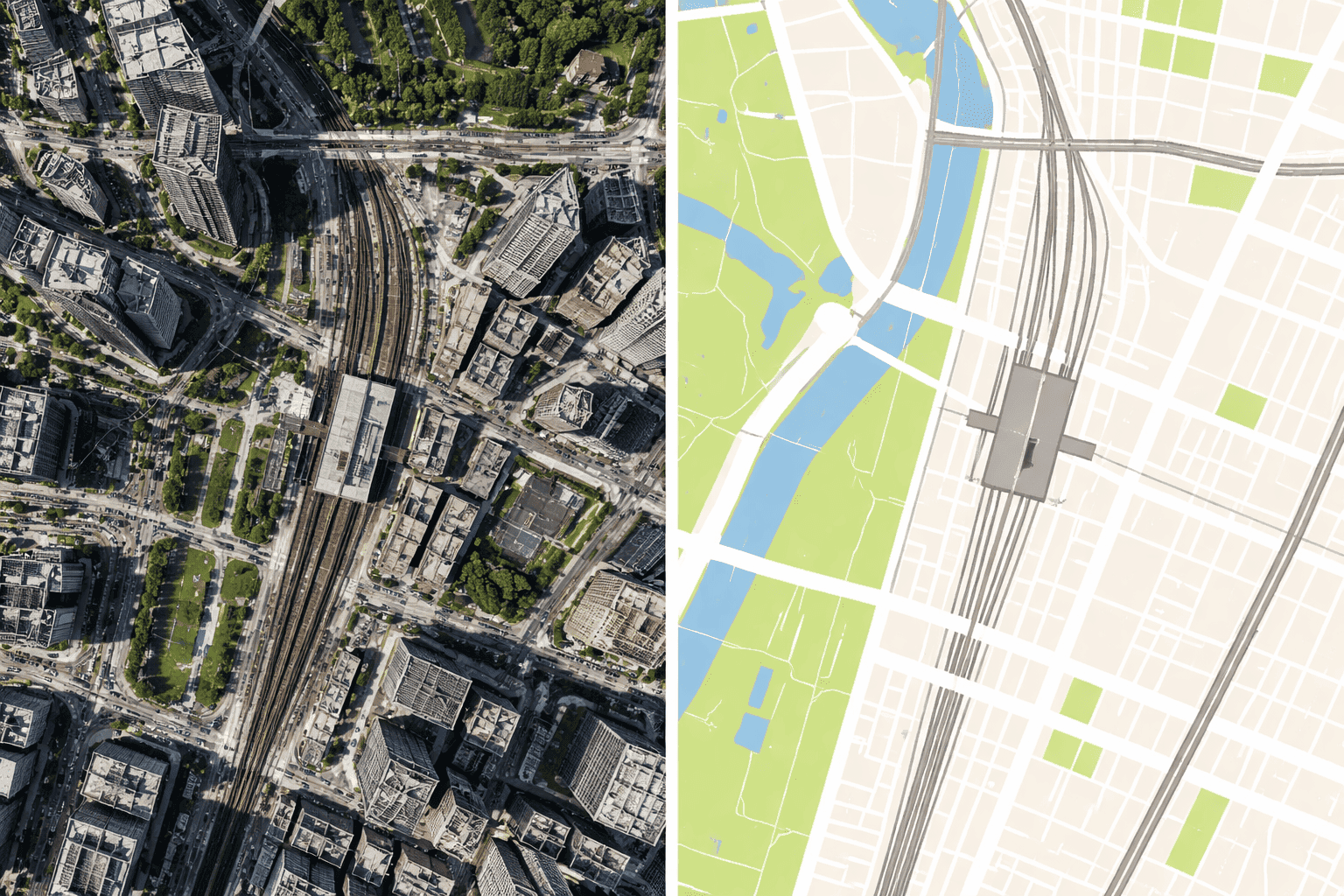
In this way, how you construct a model (a simplified representation) seems to be key to developing a mental board.
According to the player interviews from the previous section, some people do seem to use an actual board as-is for their mental board, almost like a photograph.
However, based on the research referenced in this section, a special talent for vividly memorizing everything you see does not appear to be a requirement.
The mental board image could be flat rather than three-dimensional, and depending on the position, it doesn't need to reproduce the entire board perfectly.
Additionally, some people can play blindfold chess using only symbolic information without relying on a mental board at all, which I find quite impressive.
Their approach is the opposite of those who use a realistic mental board, but this too can be called an exceptional talent.
I'd like to continue building the foundational skills to play blindfold chess in the way that suits me best.