
We use analytics cookies to understand how the site is used. They are only set if you agree. See our Privacy Policy for details.
There are three terms in chess to describe directions on the board.
Vertical lines are called files, horizontal lines are called ranks, and diagonal lines are called diagonals.
This article focuses on diagonals.
The pieces that move along diagonals are the bishop and the queen.
Needless to say, these are powerful pieces, and understanding diagonals is essential for blindfold chess.
There are two diagonal directions on the board.
Let's use the starting square of the White Queen's Bishop as an example.
The diagonals this bishop controls are called the c1-h6 diagonal and the a3-c1 diagonal.
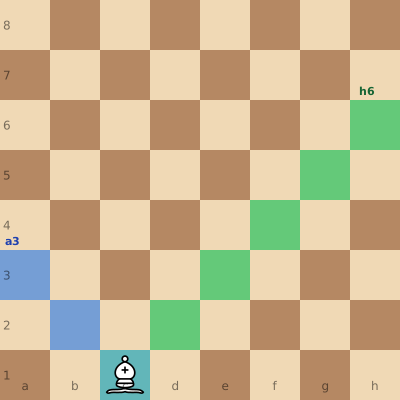
As shown with c1-h6 / a3-c1, diagonals are commonly expressed by connecting the two endpoint squares with a hyphen.
It is also conventional to write them from left to right from White's perspective.
For example, even when it is Black's turn, the diagonal is written as c1-h6 rather than h6-c1.
However, there is no strictly unified official standard, and the order of notation may vary between sources.
When playing blindfold chess, feel free to use whichever order is easiest for you to understand—don't feel obligated to follow any particular convention.
Corner squares like a1, a8, h1, and h8 belong to only one diagonal, but all other squares always belong to exactly two diagonals.
Diagonals also have the property of being single-colored.
Because the chessboard has a checkered pattern, any square diagonally adjacent to a given square will always be the same color.
For example, the a1-h8 diagonal consists entirely of dark squares.
When a bishop is placed on a square, it is important to immediately visualize the diagonals it controls.
In blindfold chess, you cannot use the color of the squares to help identify lines of attack, so some training and practice will be necessary.
A recommended approach is to name the diagonals you use frequently and treat them as patterns.
For example, if you regularly play the fianchetto, you will often place your bishop on b2 or g7.
This puts it on the a1-h8 diagonal, which is easy to remember.
Using openings as a reference is also effective.
For example, in the Italian Game, you play Bc4, and this bishop controls the a2-g8 and a6-f1 diagonals.
Giving these a memorable name like the "Italian Diagonal" can help them stick in your memory.
If you play an opening frequently, you will naturally memorize the relevant diagonals, and when learning new openings, approaching them from the perspective of how the bishops are used can also be a great way to internalize their key characteristics.
Master the chessboard's alternating color pattern for better piece coordination
Instead of memorizing 64 squares individually, use key squares as reference points. A perfect first step for blindfold chess.
By leveraging the symmetry of the chessboard, you can cut the information you need to memorize in half. Learn techniques using horizontal, vertical, and point symmetry.
Why does confusion between a-file and h-file happen? Understand the difference between fixed and variable perspective models to develop stable coordinate recognition.