A chessboard has 64 squares, but you don't need to memorize each one individually.
By focusing on the symmetry of the chessboard, you can reduce the amount of information you need to remember.
The board is symmetrical along the center axis between the d-file and e-file.
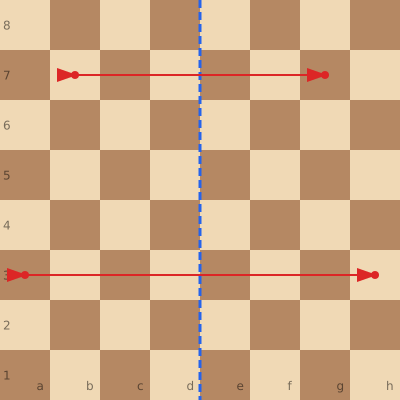
| Left | Right |
|---|---|
| a | h |
| b | g |
| c | f |
| d | e |
Applications:
This symmetry helps understand the relationship between the kingside and queenside.
The board is symmetrical along the center axis between the 4th and 5th ranks.
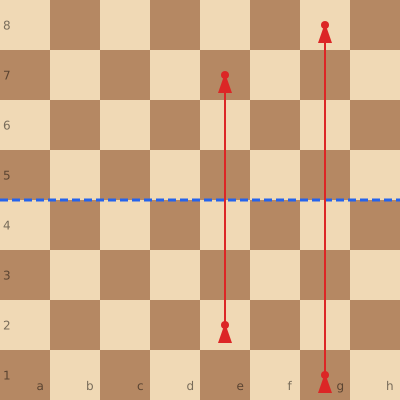
| White's Side | Black's Side |
|---|---|
| 1 | 8 |
| 2 | 7 |
| 3 | 6 |
| 4 | 5 |
Applications:
There is point symmetry around the center of the board (the intersection of d4, d5, e4, e5).
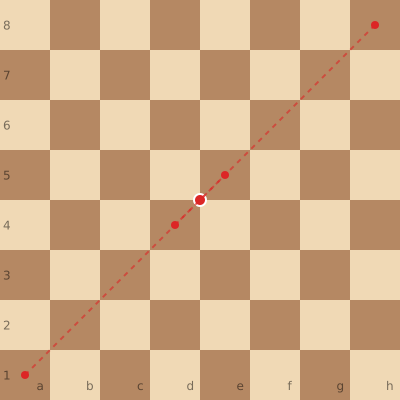
| Square | Point-Symmetric Square |
|---|---|
| a1 | h8 |
| a8 | h1 |
| b2 | g7 |
| c3 | f6 |
| d4 | e5 |
Point-symmetric squares are on exactly opposite sides of the board's center.
Note that point symmetry is a combination of horizontal and vertical symmetry. For example, applying horizontal symmetry to a1 gives h1, and then applying vertical symmetry gives h8. In other words, if you understand horizontal and vertical symmetry, point symmetry follows naturally.
There's an interesting relationship between symmetry and square colors.
| Symmetry | Square Color | Example |
|---|---|---|
| Horizontal | Different | a1 is dark, h1 is light |
| Vertical | Different | a1 is dark, a8 is light |
| Point | Same | Both a1 and h8 are dark |
Knowing this rule lets you deduce a square's color from its symmetric counterpart.
Master the chessboard's alternating color pattern for better piece coordination
A guide to diagonals—one of the three directions on the chessboard alongside files and ranks. Includes practical tips for memorizing bishop diagonals in blindfold chess.
Instead of memorizing 64 squares individually, use key squares as reference points. A perfect first step for blindfold chess.
Why does confusion between a-file and h-file happen? Understand the difference between fixed and variable perspective models to develop stable coordinate recognition.
