A chessboard has 64 squares. Instead of memorizing all of them individually, there is a way to memorize them efficiently by using specific squares. That is the Anchor Point Method.
The Anchor Point Method is a technique where you use several key squares as "reference points (anchors)" and use them as footholds to recognize other squares.
The human brain is better at recognizing relative positions than absolute positions. It is the same as how, when looking at a map, being told "2km north of Tokyo Station" is easier to understand than being told the latitude and longitude.
Similarly on a chessboard, if you remember a few reference points, you can grasp other squares like "a3 is 2 up from a1, so it's a dark square just like a1".
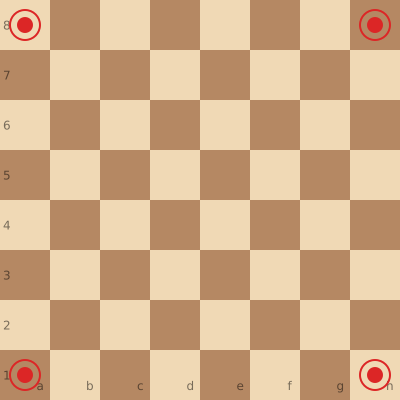
These are very easy squares to memorize and recall.
Whether playing White or Black, the top-left and bottom-right squares are light, and the top-right and bottom-left squares are dark, which is also an easy feature to understand.
Since these are the initial positions of the Rooks, I personally imagine that "pillars" exist in these 4 locations. This image helps in habituating yourself to see the entire board without falling into tunnel vision, even in regular chess, not just blindfold chess.
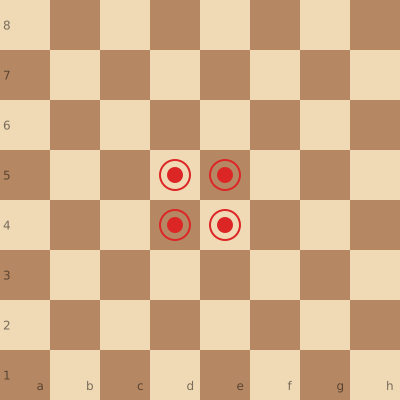
d4 and e4 are often played as the first move, and d5/e5 are also played frequently as responses. This is because controlling the center is common as an opening theory.
Frequently played squares are easy to remember, and since they are easy to distinguish from the corner squares, these are also anchor points you should keep in mind.
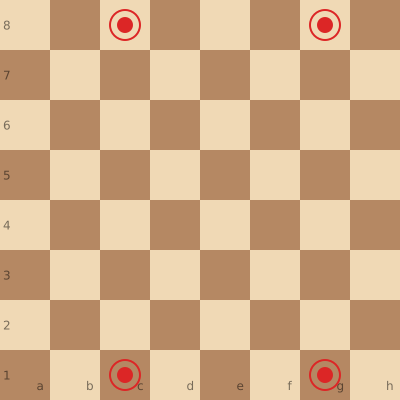
It is also good to remember the castling destination squares mentioned above. Remember that these will be the same color as the square the King was originally on.
For example, the White King's initial position is e1, which is a dark square. Whether castling O-O or O-O-O, the King's destination is a dark square.
Master the chessboard's alternating color pattern for better piece coordination
A guide to diagonals—one of the three directions on the chessboard alongside files and ranks. Includes practical tips for memorizing bishop diagonals in blindfold chess.
By leveraging the symmetry of the chessboard, you can cut the information you need to memorize in half. Learn techniques using horizontal, vertical, and point symmetry.
Why does confusion between a-file and h-file happen? Understand the difference between fixed and variable perspective models to develop stable coordinate recognition.
