
Summary
This article is long, so I will state the conclusion first.
Personally, I have decided to try the following method for board awareness (recognizing the positions of squares like e4 or d5) for the time being.
1. Divide the board into 4 quadrants
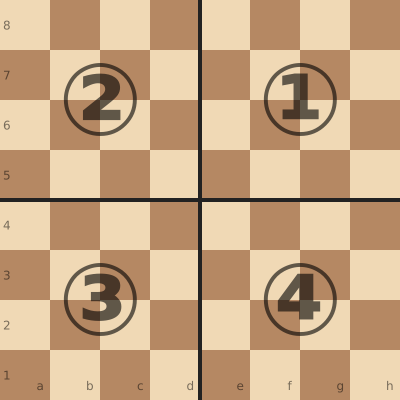
2. Use the 4 corners of each quadrant as anchor points
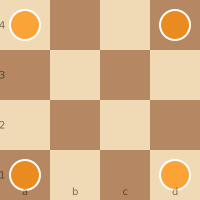
3. This results in 16 anchor points in total
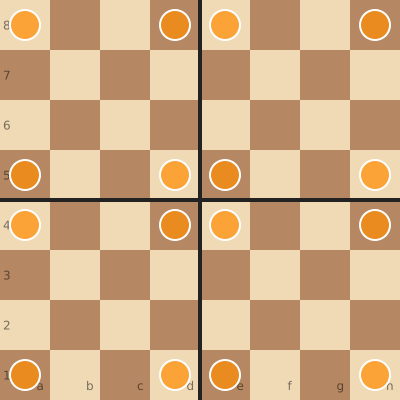
This approach minimizes the time needed for board awareness.
Whether you encounter Nf3, d6, Bb5, or any other square, every square is always adjacent to an anchor point, allowing you to efficiently identify its location.
I have named this the "Quadrant Method" and decided to put it into practice.
Background
If you are not interested in personal anecdotes, feel free to skip ahead to the next section.
In this article, "board awareness" refers to the ability to recognize the position of squares such as e4 or d5.
When playing blindfold chess, I believe it is essential to instantly visualize where a given square is on the board.
This is because the position of a square, which is immediately obvious when seen with your eyes, becomes difficult to grasp without visual information.
At best, I can only play blindfold chess for a few moves of openings I frequently play.
This is simply playing memorized algebraic notation of openings, and I have no real sense of visualizing the board.
As the game progresses, I quickly lose track of the board position.
I had assumed that by taking the "learn by doing" approach—playing blindfold chess games repeatedly—I would naturally develop board awareness, but that did not work for me.
So I tried several training methods.
1. Efficiently Determining Square Colors
There is a method for instantly determining the color of a square on its own.
It uses the odd/even number-based determination introduced in the following article.
Square color information is valuable in itself.
For example, a light-squared bishop can only move on light squares, so this can be used to verify legal moves.
Additionally, since a chessboard has a checkerboard pattern, you can also determine the colors of adjacent squares.
However, knowing a method specialized in determining square colors is not very useful for progressing through a game.
While it is worth knowing for the practical benefits mentioned above, this is ultimately supplementary knowledge.
I reached this conclusion fairly early and moved on to consider other methods.
2. Using Board Symmetry
This concept leverages the symmetry of the chessboard for efficient board awareness.
Details are explained in the following article.
The theory is elegant, and I think there are situations where it enables efficient board awareness.
However, I found it difficult to apply in practice when actually playing blindfold chess.
For example, consider the opening 1. d4 Nf6.
Using symmetry to recognize the positions of d4 or f6 in this case is unrealistic.
Let us think about the situation of recognizing 1...f6 on the board.
You would not visualize it by thinking, "f6 is symmetrical to c6 left-to-right, so it must be around here."
In the course of the move sequence 1. d4 Nf6, the symmetrically related coordinates c6, f3, and c3 have not yet appeared, so you cannot use relative positional relationships with other pieces for board awareness.
While the idea of reducing cognitive load through symmetry and the rules such as symmetrical squares sharing the same color are certainly useful, I found it difficult to use this approach alone in practice.
3. Using Anchor Points
This method uses specific squares as reference points and recognizes other squares based on their relative positions.
It is explained in the following article.
Personally, I found this the most helpful.
The 4 corner squares of the board are easy for anyone to memorize immediately, and the 4 central squares are also easily remembered because pawns are frequently placed there in openings.
Using these squares for board awareness worked best for me.
However, there were still squares like b3 or f6 whose positions I could not visualize immediately.
The common characteristic of these squares is that they are not adjacent to any anchor point.
If that is the case, I thought I could simply add more anchor points, but adding too many would dilute the original benefit. I was not sure how to proceed.
That is when I came up with the "Quadrant Method," which I will explain in the next section.
Explanation of the Quadrant Method
Dividing the Board
Processing information at the scale of the entire board is cognitively demanding, so we divide the board into 4 areas.
Dividing the board into 4 parts resembles a mathematical coordinate plane, so here I have named the areas accordingly to align mental models:
- Quadrant I ①: Kingside, opponent's territory (e5–h8)
- Quadrant II ②: Queenside, opponent's territory (a5–d8)
- Quadrant III ③: Queenside, your territory (a1–d4)
- Quadrant IV ④: Kingside, your territory (e1–h4)
Your/opponent's territory is from White's perspective.
The naming does not matter much as long as it is easy to remember.
You could simply label them A/B/C/D, or if you are already using the board's 4 corner squares as anchor points, you could name them after those corners: a1 area (a1–d4) / h1 area (e1–h4), and so on.
Setting Up 16 Anchor Points
Set the 4 corners of each area as anchor points.
Each area is a 4×4 grid of 16 squares.
The 4 corners (top-left, top-right, bottom-left, bottom-right) become anchor points.
This results in 16 anchor points in total.
You might think memorizing that many is difficult, but these are easy to learn, so there is no need to worry.
First, each area always includes one of the board's 4 corner squares.
For example, the area I labeled Quadrant III ③ covers a1–d4, which includes a1, one of the board's corner squares.
From there, you can use symmetry rules to derive the remaining corner squares of the divided area.
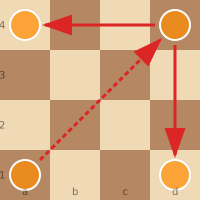
If you only remember a1, you can derive d4 by point symmetry.
This follows the rule that each board corner square pairs with one of the central squares, making it easy to remember.
For the remaining two, you derive them as the vertical and horizontal reflections of d4, which gives you d1 and a4.
The same logic naturally yields the anchor points for the other areas as well.
By leveraging this recursive symmetry, the memorization cost is minimized.
How to Use It
Once you have built this model, you can put it into practice.
The greatest advantage of this method is that every square is adjacent to an anchor point (or is an anchor point itself).
For example, suppose your opponent plays 1...Nf6.
The process of recognizing f6 might go as follows:
-
- Identify the area
- Even if you cannot pinpoint f6 exactly, you should be able to quickly determine that it falls within the upper-right area (e5–h8).
-
- Check the anchor points
- The anchor points for this area are e5, h5, e8, and h8.
-
- Determine the relative position
- Find the nearest anchor point based on the file and rank.
- In this case, you can quickly see that e5 is the most useful reference.
- f6 is one square to the right and one square up from e5, so you recognize it as diagonally upper-right.
In this way, instead of constructing a coordinate image from the entire board by thinking "the f-file is... the 6th rank is...,"
you recognize it as "upper-right area, diagonally upper-right from e5," using relative positions to reduce cognitive load and efficiently achieve board awareness.